I aim to incorporate dual charging modes, one using a proprietary cable and interface and universal USB-C for convenience. I will keep the possibility for Thunderbolt, however true implementation seems unlikely as i will need to use approved controllers. For the battery, I would like to use a 2 part removable battery
Cabling
USB-C
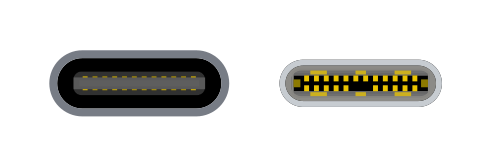
Female and Male USB-C pins
Apart from the physical benefits, I will be using USB-C it is very prominent and integrated into modern society, almost all modern devices have at least one USB type C port.
What makes Apple’s use of USB-C so good?
- Fast high power delivery: high wattage for rapid charging (for example, some MacBooks can reach 50% charge in just 30 minutes).
- Reversible connection: can be plugged in from either end and either side.
- Multi-functionality: Support for data transfer (up to 10 Gbps) and external display connections up to 4K.
- Cable quality: Threaded/braided wires withstand wear and tear better compared to previous designs.
- Performance: Variable voltage and wattage, controlling power output to optimise speeds and minimise heat.
Protocols for USB-C charging are:
- USB power delivery (3.0/3.1): High power charging of either 100 to 240 W (MacBook specifically asks the charger what voltage and current it can provide).
- Programmable power supply: A feature of power delivery 3.0, that allows voltage to be adjusted in real time (reducing heat and optimising charging efficiency)
- USB power delivery extended power range (EPR): Newer high power MacBooks use charging up to 240W (48V/5A)
Handshake and safety protocols:
- USB-C CC (Configuration Channel) lines: These physical pins on the cable are used to detect orientation and negotiate power delivery roles.
- E-Marker Chips: Cables that support over 60W (3A) charging use an active “electronic marker” chip to communicate the cable’s capabilities to the MacBook.
Proprietary version of MagSafe:
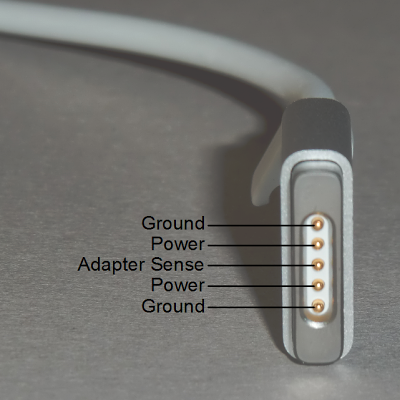
Apple's MagSafe 2
The Apple MagSafe is a very convenient charger, that works by snapping magnetically and disconnected with a tug. The charger is also asymmetrical with a small LED indicating charge status.
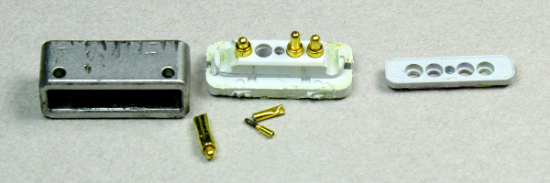
Teardown of MagSafe 2
In this teardown, it showcases that the charger is made out of pogo pins that physically connect to the MacBook, delivering the power.
My version of the MagSafe:
Taking heavy inspiration from Apple’s MagSafe, I have attempted to recreate the charging using Computer Aided Design and Electronic Design Automation.
---------------------------------------------------------------------------------------------------------
Battery
For the battery, a three-stage custom battery subsystem is what is being aimed for. By doing so there will be major Safety implications that I must risk assess before hand. The battery system should be designed along the intended Motherboard. The battery should be 3 separate modular “chunks” and I will attempt to ensure that one chunk can be removed and replaced while the computer is still running. So in essence hot-swappable redundant power system.
This will require:
- Three identical battery modules.
- A power backplane or controller that isolated each module.
- Intricate load sharing and power-path management.
- Ideal-Diode protection so one module can be removed without dropping the rail.
- Live balancing/monitored charge-state matching between modules.
- Central charger and battery management system that can handle hot swapping.
Normal 3S battery packs will not suffice as it is not a hot-swappable architecture but rather a battery voltage configuration. If you disconnect a 3S module that is feeding the machine, the rail will dip unless another source of energy takes over instantly (I may open the possibility for swapping to be done only when powered off or plugged into the wall -must make sure it is safe Safety ).
Recommended design:
5 layers
- Battery module A, B and C.
- Battery backplane or power hub
- Charging/balancing controller
- System power rail for laptop Motherboard
- Buffer holdup for “dipless” swapping.
How will the power flow?
Option 1:
Each battery module should feed the power hub, through protection and isolation circuitry. The hub combines them into one output rail using ideal-diode or OR-ing behavior, so the highest available healthy source supplies the load without back feeding the others. If one module is removed, the other two and the buffer stage should carry the load instantly, so the laptop does not shutdown or reboot.
Option 2:
The battery module with the greatest current charge feeds the battery
What the modules look like:
Each module should be a self-contained sealed cartridge with:
- Cell group or sub-pack (for power)
- Local protection/BMS
- Temperature sensors
- Keyed connector
- Latch/locking mechanism (Mechanics and design in Design)
A module can only be physically removed when it have been electrically isolated (using latch/lock system possibly)
.png)
Example of a 2 module hotswappable battery
Charger and Power Adapter
The charger and brick
What makes Apple’s chargers and bricks good?
- Safe and optimised: Apple power adapters and engineered for specific MacBook internal power management, guaranteeing safe charging parameters
- Fast charge support: The power adapters support a maximum fast-charging speed of around 0 - 50% in near 30 minuets
Drawbacks include:
- Bulky
Links:
Charging:
Battery: